
)
)
The UK’s Hydrogen Sector: Where Do We Go From Here?
Hydrogen isn’t the renewable energy silver bullet some claimed – but it’s not a dead end either. Backed by policy and real, deliverable projects, it remains a critical piece of the energy transition and a space where smart investments can pay off.
Over the past year, however, numerous hydrogen and hydrogen‑derivative projects have been shelved or delayed, sharpening scrutiny around where hydrogen can genuinely add value and which projects are positioned to progress.
Against this backdrop, while the hydrogen sector faces significant challenges, hydrogen remains embedded within EU and UK decarbonisation pathways. Its role is expected to be concentrated in hard‑to‑electrify, energy‑intensive sectors, alongside energy system integration, including hydrogen storage and the production of low‑emission fuels such as power‑to‑X (PtX).
The reality is that the market may now be entering a new phase of growth, albeit at a more realistic pace informed by data and experience, allowing the market to prioritise projects that are bankable and deliverable.
Defining viability in the hydrogen project landscape
Securing offtake remains challenging due to high production costs, infrastructure requirements and regulatory complexity, making it a critical factor for the viability of hydrogen projects.
Projects struggle where core investment fundamentals are weak, with cancellations commonly reflecting site‑specific constraints, challenges in securing renewable power and water, and insufficiently robust business cases. Limited confidence in delivery capability or management capacity further undermines the ability to secure hydrogen offtake.
By contrast, projects with robust fundamentals and credible delivery and offtake assumptions continue to progress, reflecting a more disciplined and targeted role for hydrogen in the energy transition.
Assessing viability across the hydrogen project pipeline
In this context, Arup’s latest insights piece, ‘After the hype – what makes a viable hydrogen energy project?', examines the factors that underpin bankable hydrogen projects in the EU and UK, drawing on real‑world market experience from our transaction advisory team.
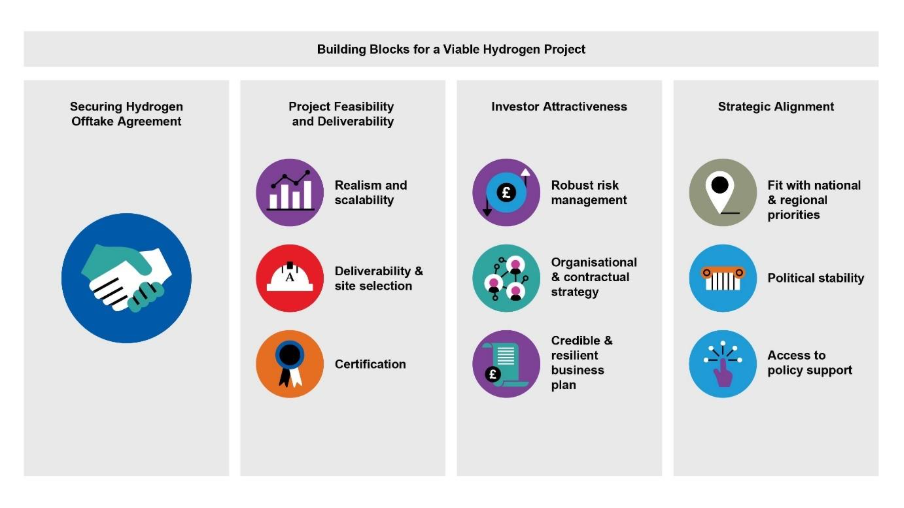
It explores the fundamentals for success in a market driven primarily by revenue certainty, setting out four core building blocks that underpin a viable hydrogen project: secured offtake, project and delivery feasibility, investor attractiveness, and strategic alignment.
Together, these provide a framework for distinguishing investable hydrogen projects from the wider market, reflecting a shift towards prioritising quality, credibility and strategic fit in the energy transition.
Read the full insight here: https://www.arup.com/insights/article-beyond-the-hype--what-makes-a-viable-hydrogen-energy-project/
Learn more about Arup’s recent projects, expertise and services for the Energy sector here.

Sally Prickett, Hydrogen & Sustainable Fuels Director, Arup
Sally is a Director at Arup, who leads the integration of sustainable energy solutions across the UK.
She is responsible for leveraging Arup’s expertise to support client projects and enable the industry collaboration required to create new value chains in sustainable molecules, including hydrogen, carbon capture and storage (CCS), and alternative fuels. Sally works with clients across the energy sector, including developers, policymakers, and investors.
Sally holds an MEng in Chemical Engineering and brings over 25 years of technical, commercial, and leadership experience within the energy sector. Before joining Arup, she spent 23 years at bp, culminating in their role as Vice President in bp's Hydrogen and CCS business, where they focused on delivering low carbon hydrogen value chain projects and developing decarbonisation solutions for customers.
Sally took part in the Innovation Zero World 2026 Energy & Grid session "Delivering Big Hardware & Low Carbon Molecules", speaking alongside Sepi Golzari-Munro, Jonathan Mills (DESNZ), Dhara Vyas (Energy UK), Tristan Zipfel (EDF power solutions), and Richard Bodal Hansen (Ørsted).