
)
)
Batteries for electric vehicles: from lithium-ion to solid-state
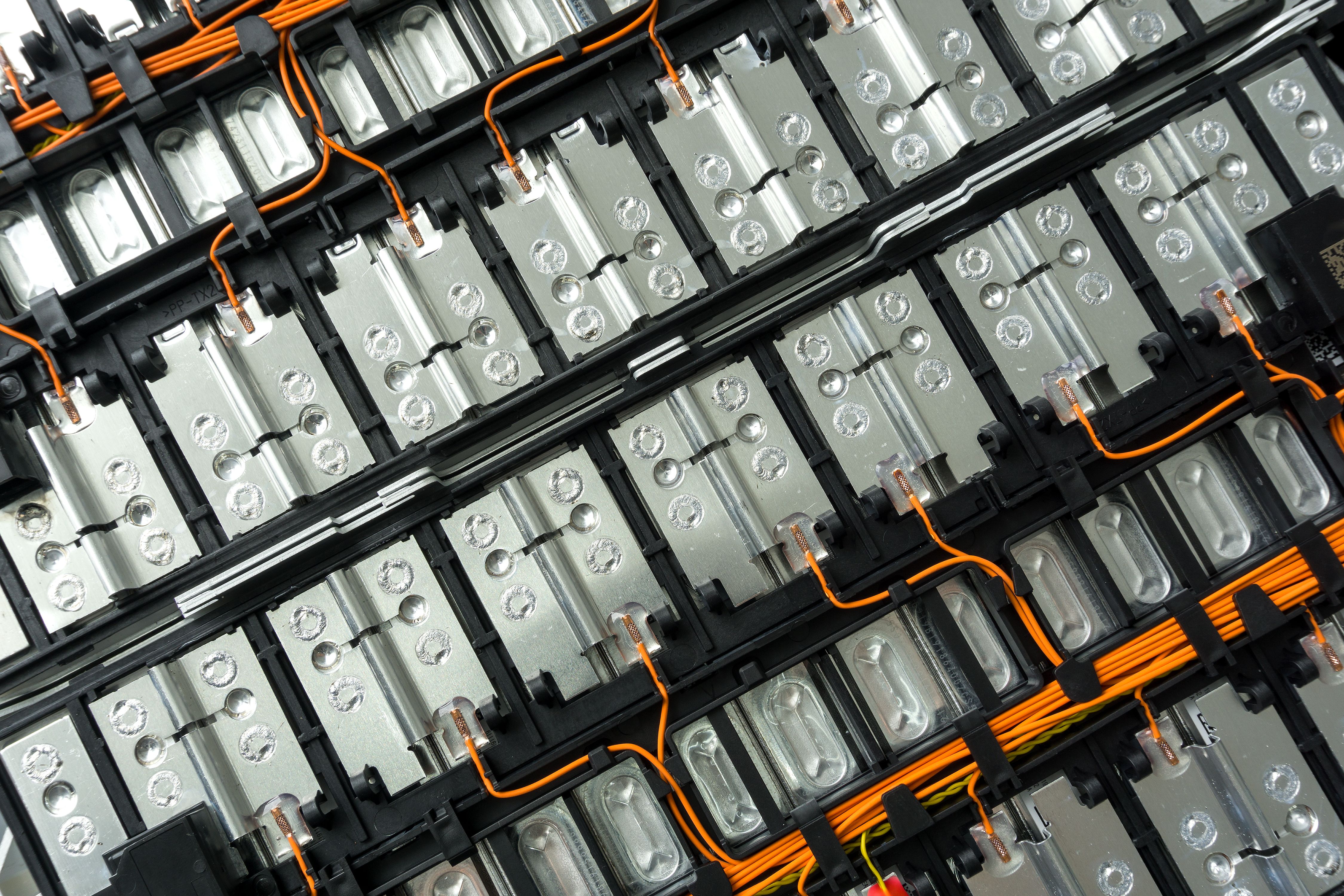
Lithium-Ion batteries
Lithium-ion batteries are the predominant energy storage solution for EVs on the road today. A standard lithium-ion battery comprises: an anode, a cathode, the separator, and an electrolyte, along with two current collectors which connect the electrodes to an external circuit. Lithium-ion batteries rely on the reversible intercalation of lithium ions into the electrodes to store energy. Intercalation refers to the insertion of lithium ions into the crystal or molecular structure of the electrode material.
During charging, a voltage is applied across the battery to drive lithium ions through the electrolyte to intercalate into the anode material. On discharge, lithium ions flow back to the cathode across the electrolyte, while electrons flow from the anode through an external circuit, providing electrical power to a device. The separator is typically a porous membrane that controls ion flow.
Lithium-ion batteries used in EVs typically comprise a lithium transition metal oxide cathode (such as lithium nickel manganese cobalt oxide) and a graphite anode. The electrolyte is typically a lithium salt in an organic solvent.
Key figures of merit
Evaluation of battery performance is based on a number of figures of merit, including the following:
- Gravimetricenergy density: a measure of energy per unit mass. Typical lithium-ion batteries used in EVs today have a gravimetric energy density of around 200 Wh/kg, depending on the anode/cathode used. A related parameter is the volumetric energy density – how much energy is stored per unit volume of the battery.
- Power density: the amount of power that can be delivered per unit mass or volume. This characterises how fast the stored energy can be released.
- As a battery is used and recharged, it slowly loses the ability to return to its original capacity – a measure of the total energy it can deliver. As a rule of thumb, the life cycle of a battery is the number of charge-discharge cycles until the battery cannot be recharged to more than 80% of its original capacity.
Other factors are of importance for applications in EVs, such as charging time, safety, thermal stability and electrode volume expansion on charge/discharge. The widespread adoption of lithium-ion technology has been driven by its reasonably high energy density, high power density and long life, although these parameters are being improved continuously.
The emergence of solid-state batteries
One of the main risks with lithium-ion batteries is their use of a liquid electrolyte, which is highly flammable and can catch fire if the battery is damaged.
Solid-state batteries replace the liquid electrolyte found in conventional lithium-ion batteries with a solid electrolyte; this is often a ceramic, glass, or solid polymer composite. Swapping in a solid electrolyte promises enhanced safety and longer cycle life.
Owing to the electrode materials that can be used in a solid-state battery, these batteries have higher gravimetric energy density (≈400 Wh/kg) and faster charging rates. All of these factors make them attractive candidates for EVs, unlocking longer driving ranges, shorter charging times, and enhanced safety.
Despite their promising attributes, solid-state batteries are not without challenges:
- Mechanical Stability. Electrode volume fluctuations due to the reversible lithium intercalation subject the battery to mechanical stress and may ultimately lead to problems such as delamination or cracking of the battery.
- Electrode-electrolyte interface. Over multiple charge-discharge cycles, the electrode-electrolyte interface may become unstable due to factors such as material incompatibility, side reactions and mechanical stresses. Degradation of this interface detrimentally affects battery performance.
- Thermal management. As with lithium-ion batteries, thermal stability of solid-state batteries is an important factor in maintaining battery health. Battery management systems are a common feature in electric vehicles today, used to manage voltage, current and temperature of the battery.
Leading automotive companies are advancing rapidly in this technology, with expectations of integrating solid-state battery technologies into commercial vehicles within the next decade. It will be exciting to see which solid-state batteries make it into commercial vehicles.
Developments in battery technology
With battery technology advancing rapidly, there are numerous exciting areas of research offering potential for innovation. These developments present opportunities for securing patent protection in a variety of areas, such as the following:
Composition
A patent application may be directed to novel and non-obvious compositions of battery components and/or methods of making them, such as alloys for electrodes or electrolyte compositions. It is advantageous for the patent application to provide data showing the improvement offered by the novel composition.
Microstructure
The microstructure of battery components can impact overall battery performance, and it is possible to claim new microstructures and methods for making them. It can be advantageous to explain how the microstructure leads to an improvement, and/or to include supporting data.
Care should be taken if the microstructure is defined in terms of so-called “unusual parameters”. Some more detailed guidance on using parameters in patent claims can be found in our briefing.
Methods of monitoring battery health
As mentioned above, current EVs include sophisticated battery management systems which are used to monitor the current, voltage and temperature of a battery. Novel and non-obvious methods for optimising battery health – such as preconditioning a battery prior to charging – can be patented.
Other inventions may focus on specific preconditioning protocols or control algorithms that effectively monitor and prepare the battery for charging.
How J A Kemp can help
Our Materials and metallurgy, Industrial and chemical processing, Polymers and Software and IT Teams bring deep experience in drafting and prosecuting robust patent applications that secure innovations in battery chemistry, microstructure, cell architecture and control systems.